

Mar 31, 2026
•
57 min
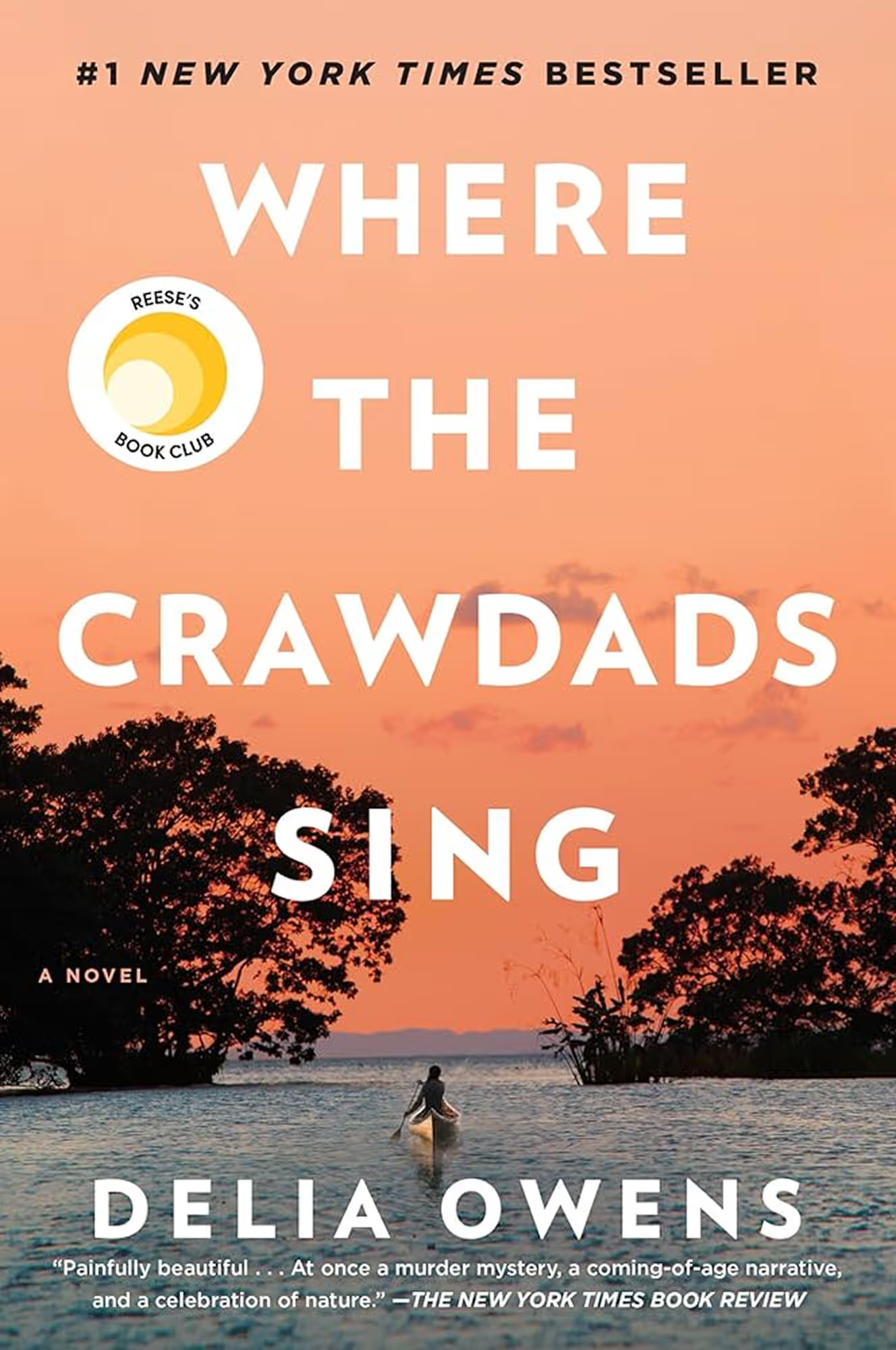
In episode six, we sink our teeth into Where the Crawdads Sing by Delia Owens. Specifically, Kya’s journey of survival and isolation, the novel’s exploration of loneliness and belonging, and how the story translates from page to screen in the film adaptation.

Kristy (00:00)
Welcome to Books I Make My Husband Read, a self-described hilarious and heartfelt podcast where I, Kristy, the devoted book lover, curate an unexpected reading list for my husband, Jon.
Jon (00:11)
And that's me. In each episode, we dive into lively discussions, humorous debates, and unexpected insights on all the books Kristy just has to make me read.
Kristy (00:21)
We're here to explore everything from your book club favorites to quirky hidden gems, challenging our perspectives and inviting you to join in on the fun.
Jon (00:30)
So settle in, grab your favorite beverage, and get ready for another literary adventure.
Kristy (00:44)
That's gonna make it in.
Kristy (00:45)
Hello listeners and welcome to season four, episode six of Books That Make My Husband Read. I'm your host Kristy.
Jon (00:52)
Jon, I'm the husband, I'm the one that Kristy makes read all these books.
Kristy (00:57)
Yes, I do. Well, here we are talking about our sixth book and film combo this season.
Jon (01:05)
Right. And if this is your first episode listening to us, especially this season, you may not be aware that this season we're discussing both the book and its film adaptation. And this week we're covering Where the Crawdads Sing by Delia Owens and the film which came out in 2022, was suddenly four years ago. It feels like it was just maybe last year, but it wasn't. was four whole years ago.
Kristy (01:32)
I know we were at dinner last night talking about this and someone said, that's recent. I'm like, yeah, a couple of years ago, a couple being four. So, so why did I pick this book for Jon? Well, one that was on the list when you look at books that have had film adaptations. It was one I had previously read.
It was everywhere when the book came out in, I think 2020 maybe. I'm not sure when the book was actually released. I remember enjoying the book. I did think it was overhyped, which I have different thoughts on now, but I enjoyed it. I thought that there was this unique story, you know, specifically to the Marsh and this like coming of age of Kya and her character.
and then also this mystery element to it as there's this murder in town, which I know you would enjoy. So I thought it would be good for the season and what we were trying to accomplish with the film adaptations.
Jon (02:32)
right Yeah,
I enjoyed it more than I think I thought I was going to. I'll just say that for the transition. We'll leave the rest for later after the swoosh. Before we get into our full convo though, we want to let all of you know we have one more book for this season and it's the most exciting book or I should say the book we've been most excited about I think this whole season and that is Project Hail Mary by Andy Weir, which the film is out now.
And then we'll have one more episode, but that'll be our season recap episode where we kind of like cover all the highlights and funny moments and things like that from the season. So one more book, one more recap episode, and then we'll take a break and come back late summer.
Kristy (03:18)
Yes. And as you mentioned, Scarlett Johansson's character, Black Widow in when she's like, all I've been doing is trying to get to this moment. That's how I feel about the season. All I've been doing is trying to get to episode seven so we can read and watch Project Hail Mary because I've had this book on my list for a while.
Jon (03:29)
You
Yeah.
Kristy (03:42)
but when this idea percolated in my head, well, knew I wanted it be a book on the podcast. I knew it was one or I thought it was one that you would enjoy. So I knew I...
had it in my head for a while that this was going to be a book we were going to do, but I also knew there was an upcoming film and I typically like to watch and read close together. So it's kind of fresh in my knowing this one wasn't released till March, we knew we had to align it with the
Jon (04:12)
season. Yeah. yeah.
Kristy (04:12)
release. Yeah, well, with the release of the movie. So we couldn't have done it early
on because the movie wasn't out yet. So we had to literally wait till our last episode to do this one, which means I had to wait to read it based on, you know, when we're recording. And just been trying to get to this moment. Yes.
Jon (04:32)
And here we are. We are finally
almost there. Yeah.
Kristy (04:36)
Yeah. And I also had this
thought that I don't know, because ever since the pandemic, just, don't know if other people feel this way, you and I used to see a lot of films and we don't do that anymore. Like how long do films stay at the theaters now? I mean, is this going to be there for a few weeks? Because we're not going to miss it, are we? Does it go right to streaming after at least theater? Is there, I don't know.
Jon (04:54)
Good question.
I hope not. I don't think so. Yeah,
I don't think so. There's I'm just okay. All right. Well, we've got two weeks. ⁓ Yeah, I mean, that's a good point, though. I actually wonder maybe we should flip these two books, but hindsight's 2020.
Kristy (05:05)
I think we need to read quickly.
Yeah.
Jon (05:18)
now though, we wanted to again, remind everyone you can follow along with us and all the books we're covering and all the books that Kristy's making you read by joining us on Instagram, TikTok, YouTube. And if you enjoy the show, which we hope you are, because you're listening, rate and review us on Apple Podcasts, Spotify or wherever you might be listening right now.
Kristy (05:42)
Alright, are you ready for that spoiler free book summary?
All right, Agent P.
Kya Clark is young girl growing up in the marshes of North Carolina, largely abandoned by her family and left to raise herself. to survive on her own, forming a deep connection with the natural world around her while the nearby town labels her the mysterious marsh girl. Isolated from others, Kya builds a quiet life shaped by resilience, observation, and her relationship with the land.
Jon (06:18)
As she grows older, Kya begins to open herself up to the possibility of love and connection through relationships with two young men in particular. at the same time, a local death draws suspicion towards her bringing her back into the community that has long judged and misunderstood her.
Kristy (06:37)
Blending coming of age, romance and mystery, Where the Crawdads Sing is a story about loneliness, survival and the human need for belonging, set against the atmospheric backdrop of the marsh that shapes Kya's life.
Jon (06:50)
Yes, it does. All right, folks, this is the point of the episode where we are about to get into all the spoilers. So if you don't want spoilers, jump in your boat and motor on out.
Kristy (07:05)
All right, let's about what we thought about the book. So I will go first. went first last episode.
When I first read this, I think was in 2020, 2021, whenever it came out, it was everywhere. It was immediately on the New York Times bestseller list.
I liked it. I mean, I liked it, but I wouldn't have told everyone they need to read it. I thought the story was enjoyable. I thought Kya's character was like really complex and a unique storyline. I felt there was like some suspended disbelief that this six-year-old could really raise herself in the way that, you know, Kya does in the book, but okay, fine. I'll get past that.
But I enjoyed the mystery of the murder that's in the book. And yeah, if someone would have been like, yeah, I enjoyed it. Should I read it? I would have said, yeah, great, fine. Could have had conversations about it. But I thought maybe it was a little I was being honest at that point in time. When I reread it for this, I was, I don't want to say blown away, but I just had different feelings. I felt.
really connected to Kya's character, not like personally connected, but I felt for her. I had a lot of like sympathy for her and what she was going through, or I should say empathy of what she was going through. I felt a way about like the townspeople and how she was isolated and treated and like literally left for herself and how that translates to later on when she's murder that happened. And
when they read the verdict and then like the end, I was sobbing and it felt, I didn't even know I was going to feel that way. And it surprised me when I'm just like crying and I'm like, wow, I felt like, guess how everybody felt when they first read it, like back when, I'm like, what did I miss the first time? Or maybe it's these, I thought, is it just that these books get so overhyped? So in my head I have,
I don't know, I've built it up so much and then I don't want to say it was a letdown, but it was like, okay, yeah, that was a good was fine. But now there's this distance and I feel removed from it. don't know, I just appreciate it in a different way that I really didn't the first time around.
Jon (09:27)
so for me, remember it being really hyped. I remember, particularly when the movie came out more so than when the book was released. I thought the premise was really interesting, but I didn't really know how I was going to feel about about the book. So I went in kind of lukewarm.
But I was pleasantly surprised. I really felt for Kya, the character, I felt angry by the townspeople and their treatment of her. It
it just really resonated. It resonated a lot more than I thought it was going to. And even like the characters Tate and Chase, which I know we'll get into and found myself like trying to piece together who done it. ⁓ Like you've
Kristy (10:13)
Yeah.
Jon (10:15)
scorned me from all of this reading that you've had me do. I can't, I can't, I can't just read a book and be like, enjoy it. have to be like, who did it? there was a clue. there was a clue. ⁓
Kristy (10:18)
That's not the right word.
I mean,
most writers write with intention, so those little nuggets, you gotta follow the breadcrumbs.
Jon (10:33)
They do.
Nuggets.
Yes. So I really enjoyed it. And then given our track record for the rest of the season, I really didn't know how the film was going to live up. but we'll get to that. So I was pleasantly surprised by that one, actually. So those are kind of my general thoughts. I I really enjoyed it. So let's get into the questions and we kind of dig in a little bit more.
Kristy (10:47)
Okay, that's true.
All right, so we've already kind of touched on this a little bit with our recaps, but, or how we felt about the book, but did you find Kya to be a sympathetic character from the beginning or did your feelings about her change over time as you were reading the book?
Jon (11:16)
Yeah, absolutely sympathetic ⁓ from from the very first pages here listening about her, her family life and dynamic and the abusive father and how everyone just left her. ⁓ And you you get a little bit more sympathy at least for the mom later on in the book on on why she left. But
Kristy (11:31)
Mm-hmm.
Jon (11:42)
Yeah, you're just leaving like a seven or eight year old to be alone with this abusive. And it was just like, what? And then, you know, of course, he's he's a drunk, so he's not going to take care of her. So she has to fend for herself. And she watched mother, you know, so she tried her best. I thought the book did an excellent job of describing like
Kristy (11:46)
She's even younger. I think she's six in the book.
Yeah.
Jon (12:05)
her trying to figure out how to survive by replicating what she saw her mom do like, okay, pour grits in a pan. shit, I burned them or you know, whatever, like they clumped together. And you know, I thought the book did a really good job of laying down that she didn't just suddenly figure this stuff out. Like she struggled with it in the beginning. And then, right.
Kristy (12:24)
Because she also doesn't know how to read. So she's
completely just going from what she's seen her mom do. So she couldn't even like look up a recipe book if she had the knowing at that young age to do that, she wouldn't have been able to.
Jon (12:30)
Yeah. Yeah.
Right, she was just replicating behavior, ⁓ conditioning herself, I guess, to some degree. ⁓
Kristy (12:47)
Which
I think, sorry, we're not gonna, this is like a later question, but also speaks the story being rooted in nature and that is what other creatures do. Like they replicate each other. That's how creatures learn from each other.
Jon (13:04)
right, right. They can't read. And then as she got older and trying to figure out life trying to figure out becoming a woman and what all that meant I just in having to figure it all out, all out on her own. And yes, she had Jumpin' and Mabel but not daily, right? Like they were touch points. ⁓
Kristy (13:06)
Right.
and not
in a way that a mother and father, you know, look over and raise a child.
Jon (13:35)
Right, So, yes, she was 100 % a sympathetic character in the beginning and didn't really change over time. It pretty much lasted through the entire book of just everything she was going through and everything she basically had to go through on her own.
Kristy (13:52)
I agree. I felt really protective over her. I felt horrible for her. I just couldn't even imagine. I would have been dead. I would have been dead. I mean, from the very beginning, when she steps on the rusty nail and she realized she needs a tetanus shot, but she obviously can't get one, I would have just died from that. The story would have been very short.
Jon (14:02)
me too. mean,
yeah.
you
Kristy (14:21)
So I did, I felt protective over her. I think that you're right. She's really easy to sympathize with from the very beginning when all these things start happening to her. And you you see the abuse, you see her mom and then her brothers and sisters start one by one leaving and then Jodie leaves and her dad, she's left there with her dad. And then she's completely abandoned and forced to survive on her own. And then you see her
resilience and just independence start to take shape and she feels like something or she feels like someone rooting And then as the story progresses, I just feel like you develop this relationship with her. You watch her grow. You see her make some, you know, probably bad choices that are rooted in her not having a, you know, traditional upbringing or raising of any kind.
Jon (15:17)
Yeah, just being naive and all those things.
Kristy (15:17)
You she's, yeah, being naive and really ⁓
allowing nature raise her in a way. And I think that takes shape with some of the way she makes choices about both Tate and Chase. And then I think when you look at the ending, adds a layer of complexity that I think maybe...
causes some readers to reevaluate her character and then some readers to maybe feel more connected with her.
Jon (15:47)
Yeah, that's fair.
Kristy (15:49)
All right, so how did Kya's isolation shape the person she became? a more supportive environment?
Jon (15:59)
I mean probably
Kristy (16:01)
I mean, we'd all
be different if we grew up in a different environment, I guess, to be fair.
Jon (16:03)
Yeah, right.
Yeah. So Yeah, I guess I'm not really sure how how to answer this question besides like, yes, I'm sure she would have been different. I think if she would have found friendships of her age, if she wouldn't have been scorned and shunned, you know, out to the to the outcast, if she would have actually learned how to be loved.
and let that let those feelings in and understand them and
Yeah, but also like at the same time.
her journey led her to be this renowned author and scientist. And I don't think
that would have taken the same shape if she would have not been so immersed in nature and growing up in the marsh and been shunned by society the way she was so
Kristy (16:57)
Very fair. She probably would have found herself in a very similar situation to her mother. for all, like, reasoning. Yeah, yeah. Yeah, I think that the isolation specifically shapes every part of who she ends up becoming. I mean, she learned survival, observation, emotional resilience, like from the marsh, as opposed to people. Like...
Jon (17:03)
Yeah. Intense purposes. Yeah. Yeah.
Kristy (17:23)
Those are things that most people are, I would say almost everyone learns from other people. But all Kya had was the marsh. So she had nature, she had the animals that live there and the way that the biosphere interacts with each other. don't even know if that's the right word, but.
while she learned some like really good skills there at the same time, like the isolation specifically makes it really difficult for her to trust other people, to navigate relationships, to know what is normal in relationships. I mean, the only other interaction she's really had was as a six-year-old with her mother and her siblings and her dad. And then she has these two relationships with these two young men in the book.
Those are vastly different. She doesn't know how to navigate though. So I do think if she grows up in a more supportive environment, she'd be more socially confident. I mean, at least somewhat, but she'd also, like you said, she wouldn't have developed the independence and the connection to nature that led to her being this author, that led to her being this expert on the marsh that we see her grow into.
Jon (18:36)
Yeah, yeah,
Kristy (18:38)
So the story alternates between Kya's childhood and the murder investigation. Did this structure work for you? Did it build suspense effectively?
Jon (18:47)
I liked the structure. I was excited that it was going back and forth. don't think the future pieces when it jumped to the investigation, I was getting enough pieces to like, keep me follow or like, keep me interested in that I was like, put take me back to the past, like, let me follow the story that way and, and kind of develop so
Kristy (18:58)
Follow the breadcrumbs.
I see.
Jon (19:08)
in the premise of it, I enjoyed of like, okay, these two timelines are going to ultimately meet together. But I was just enjoying the historical timeline or whatever you want to call it so much more than like these little moments of the sheriff and the investigation that I was like, stop, just get out of the way. Like, let me look at two and when it gets to be 1969 or whatever it was, like, we'll get there when we get there.
Kristy (19:31)
I don't care about this. You just
wanted the story to be told in order. I want the timeline. ⁓ Yeah. I don't want to jump back and forth.
Jon (19:38)
Yeah, basically, basically, I was like, I wasn't getting enough. Yeah.
Yeah, so it could have been I think that could have been executed maybe a little bit it but in general, I I enjoyed the alternating timelines. I like that kind of storytelling. I don't know if it built any suspense for me in in any way. I think I was trying to figure it out. I mean, for most of the book, I thought for sure that like,
it was going to be Tate and that had done to protect know, the clues of like his father saying, the something to the effect of good man or a true man that cries in the open and does whatever it can to protect, you know, a woman or whatever, something like that. And so was like, OK, I could see him like
Kristy (20:08)
Mmm.
Jon (20:30)
doing that, especially if he finds out what Chase did.
Kristy (20:31)
Also, what dad is saying
that in the 1950s? I'm sorry.
Jon (20:35)
Well, there had to be a couple, otherwise we'd all be fucked up Um, uh, so.
Kristy (20:38)
Aren't we?
mean, it's still not
normalized, you know, 70 years from now.
Jon (20:48)
Yeah, no, but I mean, yeah, there are there are obviously pockets of those people. but yes, I see your point. Definitely an odd man out, which maybe is meant to sort of make a connection of like, with Kya, I she was sort of an odd one out of society. anyway.
Kristy (21:04)
Yeah. Or it could speak to
why Tate is who he is because he did have this father who thought that.
Jon (21:13)
Yeah, an emotionally strong or like emotionally intelligent father figure for him to ⁓
Kristy (21:21)
I'll
be your father figure
Jon (21:23)
Nice. So yeah, the structure, I like it. I don't think it builds enough suspense for me. And I just wanted to pulled along the journey that she was going on. So yeah.
Kristy (21:35)
I just want to read it in order.
really like the alternating timelines. I thought they worked to kind of give us, especially like when we get to the trial and how Kya's lawyer is interacting with her, like you need to give me something, you like you need to act this way or whatever, like trying to like pull information out of her. It shows how
what we're learning about the isolation from her youth has translated to her as an adult. So I felt that like we were seeing her grow, but we also know what happens to her in the future, a little bit of what's going to happen to her in the future. And I feel like it also builds this empathy that we have for her because we're like, this person was isolated. They were left to...
you know, fend for themselves as a very small child. No one fucking cared about this person. And then you're accusing her of murder, which for all that we have seen with the evidence could completely be an accident. So I actually, enjoyed it and I don't, I'm not saying I think your points are valid and how you experienced the story, but I actually felt like it added to it.
Jon (22:51)
Yeah, that's fair. guess you do get of it. also, it builds the bias and it builds the prejudice against her along the way. That's a good point. I hadn't really thought about that way. Yeah. Especially in the sheriff and yeah. Yeah.
Kristy (23:01)
Yep.
or just emphasizes it. Like how the townspeople felt about her. Yeah. Yeah. And how they talked about her and viewed her.
Tate and Chase represent very different relationships for Kya. What do you think each of them symbolizes in her life?
Jon (23:22)
Ugh, symbolism. Can I just read a story?
Kristy (23:27)
What? Look at everything you learned
from the great Gatsby last episode. And you're like, mine was blown.
Jon (23:31)
I know, I know. That's true.
It was.
Kristy (23:40)
There was someone who commented on something on Instagram about one of the, like the Gatsby and that they really didn't enjoy the story. I'm like, you just didn't understand it.
Jon (23:54)
Okay, were you asking me? Tate and Chase, right. what did they symbolize?
Kristy (23:50)
Listen to the episode.
Jon (24:01)
think Tate was comfort, it equal understanding, there was a shared love of nature. And I think
I'm gonna I'm gonna I'm gonna use I'm gonna use a symbolism. There was a part in the book where she early on where she was ⁓ boating through the marsh and was going past some deer. And she's like, if I don't
act threatening, then they won't see me as a threat and I can just pass them by. And I think that was kind of like Tate for her. Tate never felt like a threat for her. And so she was allowed to like interact with him and be comfortable with him the way that in a similar kind of way. look at me go. ⁓ I can do this.
Kristy (24:44)
you
You're rooting yourself on. I can do this. I'm doing so good.
Jon (25:01)
then chase was the opposite. think chase from like a visceral in or not visceral, but like an inherent, I think her guard was always up with him. But she was her isolation and her loneliness, I think, blinded her to or allowed her to sort of look past gut feeling that she had of danger and
know, wound up.
you know, costing, costing is not the right word, but ⁓
he turned out to be exactly who you know she I think she knew he was but wanted it to be different because she was so alone. So
Those are my thoughts.
Kristy (25:47)
You're so proud of yourself.
Jon (25:48)
I'm a little proud of myself. That was pretty
good. At least with Tate, Chase is a little, I mean, I chased from the very beginning. I was like, Ooh, the dirty little rat. He's gonna be, he's gonna be trouble. So it wasn't, it was no surprise that he turned out the way he did. It is also kind of amazing how you can hear two different people basically say the same words or very similar words.
Kristy (25:52)
I'm proud of you too.
Mmm.
Jon (26:18)
but have completely different motivations behind those words. So I thought that was pretty interesting, especially that came through in the film for me. So anyway.
Kristy (26:23)
So true.
Yeah.
Jon (26:30)
Lay it on me. Lay the symbolisms.
Kristy (26:32)
Well, I don't even mean to talk about a symbolism, but now that we're on that path, as you were talking, this actually formulated in my head. And I think that there's so much of the story that maybe I don't even understand that was intended by the author that is rooted in nature. And so if you think about these two characters and their relationship to Kya,
and how they shaped her, but also think about that as it relates to nature. I think that Tate is like, I am one with nature. You know what I mean? He shows her how to survive there. He shows her how to grow and really thrive. And that comes about with like teaching her to read and write and like how she navigates the marsh and like things that she doesn't know she learns.
Tate's very patient with her. Like nature takes a long time to grow and develop. And like, I think that Tate becomes this like dependable, steady, reliable thing or person in this case that she can rely on like the marsh. It's predictable. You know, Tate is that predictability in nature. Where Chase, you know, he's dangerous. He's unpredictable. He's, he's the predator in this story. And he's the, if we're thinking about nature, like
or talking about this as a metaphor, like, yeah, exactly. And Chase is the predator. So he's like this storm that's coming in or the lion in the tall grass, you know, he's charming and he's appealing on the surface, but there's this unpredictability that creates this tension in the story and what his true motivations are. You know, he's snake, I guess, snake in the grass in a way, like what is like the true intentions of like him being there?
Jon (27:59)
She's a prey.
wolf and sheep's clothing kind of thing.
Kristy (28:26)
And right.
Yeah. So I think he represents this real, real threat to Kya and her world and then how she ends up.
or like really the effect that it has on her and how she and then and then how she has to respond in turn.
Jon (28:43)
Right. Right.
Kristy (28:45)
which
we'll get to in a little bit.
So we've said this a little bit already, but nature plays a huge role in the novel. How does the Mars shape the story and Kya's identity?
Jon (28:57)
Uhhh...
Kristy (28:59)
It does.
Jon (29:00)
It does. I
mean, it's it's it's her complete identity. And I think that comes to fruition at the end when after she passes that she's like, I am. I am now the, the marsh I am the grass and growing the water. Yeah, yeah. And where she belongs and
Kristy (29:19)
It's like circle of life. Yep.
Jon (29:25)
I don't kind of like what one of the first questions is about if she had grown up with more support around her lovers and support around her would have changed her I think this is a similar question just kind of shaped a little differently if if she hadn't grown in the marsh and nature didn't play that parental role. think her identity would be completely different.
Kristy (29:51)
Yeah. We talked about this a little bit already, but most people learn how to act, how to behave, how to navigate life from people and Kya didn't have that. So,
nature and the marsh specifically are her home, are her teacher, are her refuge from everything else. And that shapes her worldview, that shapes her survival skills or teaches her survival skills, it shapes how she understands relationships. Like think about how she talked about insects and know, like the praying mantis is like biting the head off of its mate.
Jon (30:23)
The insects.
her mate.
Kristy (30:29)
Right. And like, so this is how she thinks because this is the only thing she knows. So she learns from nature and that just like shapes who she is. It's the constant in her life when people aren't there and it's how she learns to navigate the world and how she learns to navigate human behavior. Even though we know that how animals and insects behave is not how we behave as humans. Like Kya doesn't know that.
So ultimately the marsh and nature really become inseparable from her identity because she doesn't know anything else, because she hasn't been enough around enough people to know these things.
Jon (31:09)
Right, Truth.
Kristy (31:12)
So guess kind
of continuing on that, How did the town's perception of Kya influence her life? Did she ever truly escape being labeled the Marsh Girl?
Jon (31:24)
No, I don't think she did. But I think she took ownership of it from a slander to a proud label. In the beginning, you know, it being used as a disgrace as way to discount her as being different.
Kristy (31:30)
Mmm.
Jon (31:47)
And then through journey and growing into adult and becoming this author and really becoming like the the expert on the marsh, the marsh girl takes a whole different meaning and which is why Tate, you know, at the end keeps the label for as as the marsh girl because he feels like it's no longer
that derogatory that's what I'm trying to find is no longer a derogatory term. It's not like no, she is she is the Marsh expert. She is the Marsh girl. So so the way it influenced her is it changes over time. But I don't think she ever escapes it. Well escapes the derogatory meaning of it, I guess. Yeah.
Kristy (32:17)
Yeah.
Yeah, I think, right.
Well, for her, but maybe not the townspeople. But yeah, definitely for her. I think she sees it as like, it's really slander to start. And it definitely is that when you see how they treat her and she's perceived while she's going through the trial and in her youth as well. But then you're right.
Jon (32:34)
Sure.
Kristy (32:55)
it actually becomes this ownership of like, this is who I am. I am the Marsh girl, but...
There's ownership in that and there's pride in that because no one else is, you know, an expert like she But also there's
Jon (33:05)
Pride, yeah.
Kristy (33:11)
She was made to be that. And I don't mean she was born to be that. mean, like they created her. This is, she is a product of what the town's people did. And by did, I mean, did nothing for her, except, you know, for a handful of people, less than a handful of people. They created, like they're responsible for this, which I think comes out in the trial and how they, with a verdict that we hear.
Jon (33:19)
Yeah.
Right.
Kristy (33:41)
But I think like they are responsible for this. Like they made this person. Making of a Marsh Girl.
Jon (33:41)
Yeah.
Yeah, and I think, ⁓
yeah, ⁓ Netflix series. ⁓ Yeah, and I think Tom, her lawyer's closing statements, I thought were very powerful and impactful and.
Kristy (33:56)
Yes.
Jon (34:01)
emphasize the point you're just making is like we failed this girl through her whole life as a society as know, a small close knit town as we are. And now we're going to pin a capital murder on her and because she's different, and because it's easy to point a finger. I thought his closing statement was just outstanding.
Kristy (34:26)
Yeah, I agree. So did the ending change how you interpreted Kya's character or the story as a whole?
And specifically like after she dies and Tate makes his discovery.
Jon (34:34)
I thought.
Yeah, he discovers the yeah,
no, I don't think that changes. actually think it it makes total sense to me. The way she grew up all the all the clues by the author around the reference to the fireflies, the praying mantis to all of those things and like, it makes total sense. So I was not surprised. I don't condone murder, obviously.
But I'm like, okay, that's pretty.
pretty, that's the word I'm trying to think of.
Kristy (35:17)
Justified?
Jon (35:18)
Yeah, maybe. know. I'll think of it, but.
Kristy (35:22)
So first time I read it, I was not like you. You said you were convinced maybe that Tate did it. I don't remember if I had those feelings, but I remember thinking, no, she didn't do this. Like they're trying to pin this thing on her. It very much could be an accident. However, even if it's not like there is not enough evidence to say that she did this. I very much felt that way, especially when she's talking to Tom and she's like,
I'm not going to say I'm guilty. That's what she says. I'm not going to say I'm guilty. And then I know what happens. And then when I read it the second time, I'm like, ⁓ she never says, ⁓ I didn't do it. She says, I'm not going to say I'm guilty because to her, she is not guilty. She is justified in her actions because she has learned how to behave.
Jon (36:05)
I didn't do it.
Right. It's nature's way.
Kristy (36:20)
from nature. And in nature, you cannot live wondering every day if you're going to be prey, if you're going to survive, like all those things like as a animal thing in nature, a living thing that's not a human being in nature, like you adapt, you make changes, you evolve. That is what Kya did. She survived.
Jon (36:45)
survived.
Kristy (36:47)
And that was her instincts
because she's learning it from nature, not from human behavior or laws really. So...
Jon (36:52)
Yeah. Yeah. And she says
at one point, like, if there's one thing to live day by day alone is another thing to live alone and in fear or something like that. And so like, okay, yeah, so eliminate the fear and you can go back to being at peace.
Kristy (37:05)
Right, right. Yeah.
All right, so let's transition to the film. Do you feel the film captured the atmosphere of the marsh as effectively as the book does?
Jon (37:23)
Hmm, I think it's pretty good. I think the way I pictured it in my head, it was I'll say like, a little rundown or ⁓ not condensed, but like dense. So meaning that like the shack in the in the movie I thought was actually pretty well.
built and like maintained yet. I had in my head it was probably a little more rickety. ⁓ And
Kristy (37:52)
totally. I mean, I don't even,
I think that they had a pump for water and I don't remember that being a part of, yeah. I was like, there was an outhouse, there was no electricity, there was no running water. Like that's how I thought of it.
Jon (37:59)
of the book either. Yeah.
Yeah.
And just even like the waterways and things like that I pictured them to just be like little narrow little like little capillaries at the boat could just barely kind of like maneuver through as opposed to like these wide almost streams they they look like. I felt like the lushness would be was would be more dense than it wasn't in the film.
Kristy (38:21)
Mmm.
Jon (38:29)
⁓ but I also get it that like, it's a film and you have to have sort of like enough clearance to have like a visible picture and, scenes and things like that. I thought it was, I, I thought the atmosphere was, was fine for, for the medium. What did you think?
Kristy (38:38)
Yeah.
Yeah.
I felt that the film does a really good job of capturing the beauty of the marsh, which is not something that I felt like you did. Like it was more rundown and not just her home, but like the marsh itself. thought more, I was actually thinking more swamp-like, which there is swamp and there is marsh, but in my head I had like this swampy setting and on screen it was beautiful.
Jon (39:08)
Yeah. Yeah.
Yeah, that's true.
Kristy (39:18)
And so I
felt like the film visually brings that to life, like the beauty of it, the nature, like, you you see the birds and you see, you know, insects and things interacting with each other. But I do feel the book, of course, because it has longer to do so, like goes deeper into how the marsh like specifically connected with Kya, which I think is a big part. And...
What I feel like was probably missing was how in the book, the marsh feels like a character. And I don't feel like that translated to screen, but again, you only have so much time to do so.
Jon (39:58)
That's fair. Yeah.
Kristy (40:01)
handle Kya's isolation compared to how it's portrayed in the novel?
Jon (40:05)
I actually thought the movie did a pretty good job. I appreciated that they showed scenes from when she was young and and show those moments that she was abandoned by all these individual people and that it didn't just immediately jump to her older years.
thought the scenes of her boating alone of just being in the shack alone, I thought did a decent job of like, portraying that that isolation.
yeah, I thought I thought it did. I thought it did pretty well. What about you? What did you think?
Kristy (40:46)
don't feel like it really captured her loneliness.
For me specifically, I actually disagree with a couple of the points. So her time jump. So you have young Kya and then you have Daisy Edgar-Jones, who's playing the adult version of her. And I feel like you needed another actor in between playing, you know, maybe a tween. Because I feel like we see six year old Kya when she's left and then boom, we see adult Kya. Now I think that when she's first with Tate, she's 14 or 15 in the book.
Daisy Edgar-Jones does not look 14 or 15 at any point in this movie. So I feel like you needed someone else to represent that character. And I guess Tate's character as well, because it just felt like the same period of time for me. so there's that, but then in the book, there's these so much of, it's just Kya doing her thing, figuring things out.
Jon (41:27)
Yeah.
That's true.
Kristy (41:46)
And on screen, she spends a lot of time with other people. Think about how often she's in town, how often she's at Jumpin's. Now, she does do those things in the story or in the novel, but she does them a few chapters away from each other. in the movie, it's mostly like she's visiting Jumpin's, she's at the Piggly Wiggly. I don't think they, when she goes to town, I always...
Jon (41:50)
That's a good point.
Kristy (42:15)
pictured her like, I don't know, nervous and, you know, trying to interact with people where on screen it didn't feel like that at all. She's just like walking out and like, hi. hi, Chase. Like, I don't know. It just, I don't feel like it really captured the loneliness and isolation that she probably felt, especially as a child on screen. Again, you don't have long enough to tell the story, but for me, that was a miss.
Jon (42:20)
Yeah.
That's, yeah,
I think that's fair. I think that point about how many pages you get when it's of just being her, you're right. That is where you really get that sense of it's she's alone and figuring this all out on her own. And you're right. That isn't really that that is missed on screen. Yeah, good point. I missed that part.
Kristy (42:54)
Yeah.
What did you think of Daisy Edgar-Jones as Kya? Did she match how you pictured the character while reading?
Jon (43:10)
Actually, pretty surprisingly well I thought she was an awesome cast choice I to one point I she's very beautiful and I don't I think I had my head was a little more homely looking
Kristy (43:26)
interesting because both Chase and Tate are like, I think that's why Chase like pursues her because she's very beautiful.
Jon (43:35)
Yeah. Like the, the child version of Kya in the movie, I actually thought was like a perfect cast stylistically or whatever. I, again, I thought she was a great cast choice, but when I was reading it in my head, I just, took her to be a little bit more homely.
I thought she did an excellent job capturing the shyness of the character though and like the meekness and just vulnerability. I thought her little like micro expressions through the film were just.
Kristy (44:04)
vulnerability.
Jon (44:11)
I thought she captured the essence of it really well. But yeah, just like visually. Yeah, anyway, so that's my answer.
Kristy (44:20)
I agree with that in general. think that especially when we see her first interacting with Tate with the feather and she like gets all excited like a kid would because she's very childlike in her like teen and tween years because she doesn't know any better. And we see her like very nervous and like when she snatches the feather from you Tate
Jon (44:31)
Mm-hmm.
Kristy (44:49)
when he's trying to give it to her and then she like also passes one she has for him, you she's scared to get too close to him. And so I thought that was really good. And I thought her in the trial was really good and showing, you know, everything you're describing and like her awkwardness and shyness and like her, you know, lack of emotional intelligence and understanding of what is really kind of really going on, felt like.
But it was her interactions, I feel like as she got a little older and then like specifically with Chase, she just felt a little too confident and outspoken that she didn't, I don't think was conveyed in the book, but she was on film. And again, that's writing, that's not the actor's fault, but I did feel like, like, I don't think she would have said
Jon (45:36)
Yeah, actually as you bring that up, it reminded me something as I was watching it. The,
There was a very thick accent written on the pages in the book and I don't think that translated to the film either. It was very clear English and I wanted more drawl. I wanted that like southern's marshy I thought Tate and Chase's character had the most of it but for her like I wanted more from her especially since
Kristy (45:47)
Yes.
Yeah, it's very true. Yeah.
Jon (46:05)
she didn't have traditional education and like, you know, Tate worked with her to change some of that, but there's still a lot of that in her adult years left. I think I wanted more of that from the film.
Kristy (46:17)
Yeah,
very true. So speaking of Tate and Chase, do you feel like they felt different in the film compared to the book? And if so, how did that change your perception of the relationship with Kya? And we already talked about this, not in this conversation, but together, but like, why did they basically look like fucking brothers? I did not like that cast choice at all. Both actors, I felt like did a fine job, but that the fact that they looked alike,
Jon (46:37)
they totally looked like brothers, yeah. Yeah.
Kristy (46:45)
did not set with me.
Jon (46:47)
Yeah, on such different ends of the spectrums behaviorally that when they're when you look at them, and they look so similar that was that didn't quite align.
Yeah, it was just hard to distinguish the two a little bit because they look so similar on screen. But how did they
Kristy (47:02)
Yeah.
Did how they were portrayed on screen change your perception of their relationship with Kya?
Jon (47:12)
no, not really. And I think one of things that struck me while watching the film, especially was how two people can say very similar things, but have very different motivations and meanings behind them. And I think that really came through with Chase's character in the film of just like,
saying how he's gonna, when they get married, he's talking about all this future stuff and how he keeps apologizing and blah, blah, blah, blah, blah. And you know, it's just slick with snake oil and where Tate's is, you can see it, you could see it in his eyes in the film too, how genuine he was when he was saying the same words as opposed to when Chase was saying those words.
Kristy (47:57)
Yeah,
yeah. I think I would agree with that, but I think in general, like both their characters were just simplified in the film. we're gonna say this over and over. I feel like that just goes back to the length of time you have on screen. And you know, a two hour film is not gonna, you're not gonna able to portray those things. I think Tate still comes across as kind. He still comes across as supportive. He's still,
Jon (48:08)
Sure, yeah.
Kristy (48:27)
comes across as like really caring and loving Kya, but it just feels condensed. Like we just don't get enough of him and their relationship and how they grew up together in a way, you know, in their teens and then what it really meant when he left. And also like the one thing I actually feel the film failed at is the length of time between when he goes away.
Jon (48:39)
Yeah.
Kristy (48:53)
And then she actually starts her relationship with Chase and the loneliness and despair and disappointment she felt when Chase left, or sorry, when Tate left her. And then meanwhile, Chase feels less complex, like you were kind of saying, you know, like, yeah, he's selling snake oil, but...
Jon (49:04)
Yeah.
Kristy (49:14)
I feel like maybe if we didn't know that from the book, I wouldn't have felt that completely on screen. I might've felt like, oh, maybe he actually like really does care for her. But in the book, like I feel like we get that he really doesn't, that something else is going on there. So I felt like they were portrayed more straightforward on screen where they're like really complex in the book. And it gives like nuance to how Kya is experiencing both of those relationships in a way that it's...
Again, I'm not saying it translated poorly, but it just didn't have the same effect as it did in the novel.
Jon (49:50)
I would agree. I would agree with that.
Kristy (49:52)
Do you feel the ending landed the same way emotionally in the film as it did in the book?
Jon (49:57)
I think so. And I say that because I did in the film as we were watching it, like felt a little constriction in my throat, you know, so I'm like, okay, there's a little emotion happening there. And I think that speaks to, despite our...
issues with with her Daisy Edgar-Jones being cast for the full spectrum of her age, I think it speaks to her performance, and that we were still able to connect and have this like, sympathy with her and understanding of how isolated she was and how how she was treated and how you know, this was a win.
really for her and it's sort of acceptance in a certain way. And then the very end when Tate finds the reality in the poem and the necklace.
I thought I did. I thought it landed very similar for me. You had a few tears sitting next to me while we were watching, so I assume you were the same.
Kristy (51:06)
yeah.
I thought two parts, you've already talked about one is the, which I thought was good in the book and I thought was also good on screen is the actor who played Tom, her lawyer did a really good job at closing arguments and making the townspeople feel like you did this. Like I actually feel like he was saying whether she did it or whether she didn't.
Jon (51:24)
Yeah.
Kristy (51:39)
This is your fault. And are you going to keep punishing her for what you created?
Jon (51:46)
Yeah, there was that scene in the movie and it was in the book too. I don't remember if they're in the same spots or delivered the same way. But in the movie, Tom was saying, you know, I understand why you hate them. And she's like, I never hated them. They hated me. They disowned me. They blah, blah, blah me. Yeah. And like, ⁓ man, that hit. And I, and I think that's what, you know, obviously bottom sparking his
Kristy (52:02)
Right. Yeah.
on me. Yeah. Yeah.
Jon (52:15)
closing arguments and you're right. Oh, she said, they're not judging me, they're judging themselves. And that was like, oh shit. Yeah.
Kristy (52:23)
Yeah, right, exactly.
Yeah, so there's this part of a very like old, very, very old, I mean, when you can consider it a classic or just like, no, no, not from the eighties. my gosh, and I'm not even gonna go there. Utopia by Thomas More. And I'm not gonna get the quote right, but it's essentially like you starve your people and then they have to steal food. And so like, basically you create thieves and then you punish them.
Jon (52:35)
the 80s.
You
Kristy (52:55)
And so I think that was the lawyer's intention. Like you have created this person who has just had to survive on her own, who has had no human contact. You've made her and now you're punishing her for what you created. Right. She's not the villain. You are. And so when they read the non-guilty verdict, I shed some tears.
Jon (53:10)
Villainizing her. ⁓
Kristy (53:21)
And then, yeah, when he finds the necklace and he's like all sad because she's, she died.
I was sad too. Now I will say I didn't like that he found it in the book. I thought that was kind of lame because there made this whole point that her house was like thoroughly searched in the trial and nothing was found. I'm like, ⁓ you all didn't look. You all didn't look very hard if that's where it was. I feel like there needed to be more mystery. Like he was, you know, packing up the house or whatever he was doing.
Jon (53:33)
Yeah.
Yeah.
I had the same thought.
Kristy (53:55)
and found it someplace. didn't need to be in the floorboards or wherever it was in the book, but it needed to be a little bit more shrouded in mystery than it was on screen. But no, I enjoyed it. I thought that was, you know, good. I like the ending of the story. And I just like have to ask, like, if you found out I killed someone post death, like, would you keep my secret for me?
Jon (54:03)
I agree.
Yeah. What are they going to do?
Kristy (54:30)
mean, there.
Jon (54:30)
go drop a necklace and
or whatever, whatever evidence I find, like, yeah, I think if, we were put in, not in that, like, exact environment, but like the scenario, like, yeah, I probably would have done what Tate did and be like, well, I guess I'm taking that to my grave. And yeah, totally. And I would have, I would have felt the same way, whatever your legacy was.
Kristy (54:49)
think it's more like he wanted to protect her legacy. Yeah. Yeah.
Okay, so of course, final question. Do you have any other thoughts about this book? Would you recommend it to our listeners and should they watch the film?
Jon (55:06)
No final thoughts, shock that we haven't already covered. I would recommend it. I think if somebody asked me like, should I read this book? I'd be like, yes, it's a satisfyingly complex story, ⁓ a character driven story. And yes, there is like the threaded murder mystery to it, but that is definitely not, I wouldn't say the front and center. It is the background piece of it. And I think...
Kristy (55:26)
It's in the background. Yeah.
Jon (55:31)
as long as you go into with that lens, I think it's a very enjoyable story. And the film, like I mentioned, it's, asked me if they should watch it, like, yeah, I mean, it was fine. I think I rated it six, which, you know, for giving some of the other films adaptations we've watched, like, that's pretty solid. So.
Kristy (55:51)
Yeah,
I agree. think it is one of the better adaptations we've seen this season.
think the book's worth reading 100 % and then yeah, if someone said, hey, I'm gonna watch the film, I'd be like, okay, cool. I wouldn't be like, oh my gosh, please go watch this film, but it's worth two hours of your time. It's enjoyable. Yeah. Yep.
Jon (56:09)
Yeah, and we can talk about it afterwards.
Kristy (56:13)
All right, well, with that, we wanted to remind everyone that the next book in our lineup is Hail Mary by Andy Weir. That will be the last book that we cover this season. Then we'll wrap up with a recap episode and then we'll see you all again later this summer. a free way to support our show is by leaving us a review and rating us on Apple Podcasts.
If you don't want to rate us, but you have a question or feedback on the show, you can email us at booksimakemyhusbandread at gmail.com. We'd love to hear from you.
Jon (56:42)
And be sure to tell some other book lovers in your circle or outside of your circle about the show. Maybe there's a book we've covered they've read and they would love to hear our take on it. And then if they hear our take and they agree with or disagree with it, shoot us an email. Tell us about it. We'd love to hear from you.
Kristy (56:57)
No.
Yes, we'd love to. Well, I guess that's it.
Jon (57:03)
Yep, there's another one in the books. And now it is time for the madness.
Kristy (57:09)
Well, who knows, maybe this will be the one your husband reads.
Jon (57:13)
Perhaps. Well, bye.
Kristy (57:15)
See ya.
podcast, books, audiobook, book reviews, book analysis, book review, book community, book recommendations, book podcast, fiction lovers, must read, novel, adult fiction, fiction, literature, delia owens, murder, mystery, the marsh, north carolina, swamp, crawdads, contemporary


